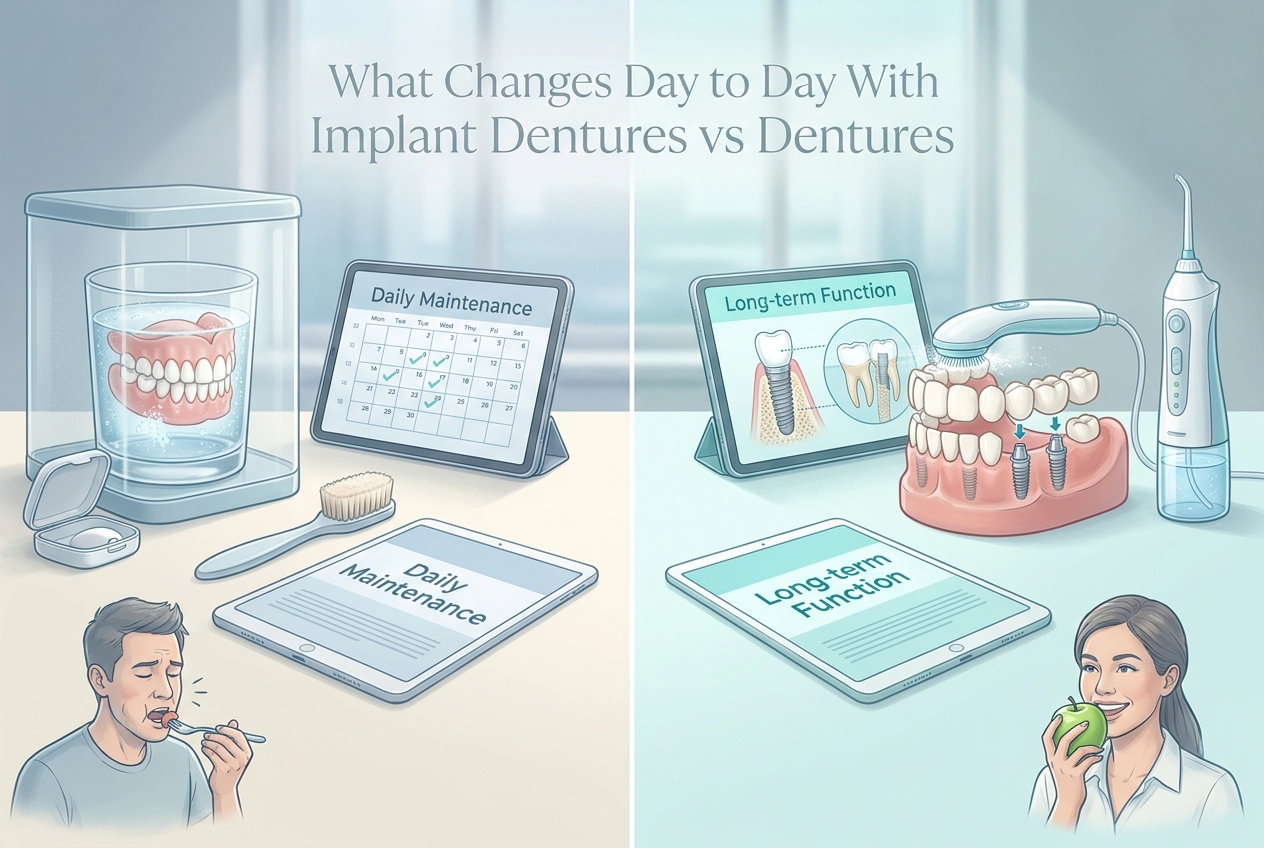
Choosing between implant supported dentures and conventional dentures can feel like standing at a fork in the road, except the signposts are written in clinical language. Let's translate. This post compares the two paths by what you actually feel day to day: retention, chewing, sore spots, bone change, cleaning routines, repairs, adjustments, and how often you're in the chair.
We'll also explain when a well-made conventional denture is the better first step. Implant supported dentures can buy stability and chewing confidence, but they ask for surgery, healing time, and more involved upkeep. A conventional denture remains a legitimate, simpler, repairable option when bone, health, or budget make implants a poor fit.
You'll get a side-by-side view, plus what no clinician can promise either way, so you can weigh the choice with someone instead of being sold to, then make the call for your own week. The goal isn't to crown a winner, but to help you see which path fits your mouth, your health, and your daily life.
Two Paths, and the Question That Actually Matters
A denture is recommended, and suddenly there are two versions of the same idea. One sits on your gums. The other clips onto dental implants.
A conventional complete denture is removable and rests on the gums. An implant-supported denture is also removable, but it anchors to implants placed in your jaw, usually two in the lower jaw.
One terminology trap matters before you read further. Most research compares implant-retained overdentures with conventional dentures, not fixed full-arch implant bridges that never come out. Keep those separate in your mind.
So the useful question isn't which option wins in general. It's what changes in your day, your week, and your bill, and what stays exactly the same.
The next sections walk through both paths side by side, in plain terms.
Implant Dentures vs Dentures: The Side-by-Side View
Here is the whole comparison on one screen.
Implant overdenture | Conventional denture | |
|---|---|---|
Retention | Clips to implants, steadier | Rests on gums, shifts |
Chewing | Firmer bite | Softer foods easier |
Sore spots | Less friction, still possible | Pressure points common |
Bone change | Load slows shrinkage | Ridge shrinks over time |
Cleaning | Denture plus implant care | Brush, soak, adhesive |
Repairs | Worn attachments replaced | Relines, repairs |
Visits | Surgery plus healing checks | Fittings, later adjustments |
Surgery | Yes | No |
Time to smile | Longer | Sooner |
Treat each cell as typical, not guaranteed.
The visible literature favors implant-supported overdentures for retention, chewing efficiency and satisfaction. Patient-reported findings from a 2024 study (detailed in the sections below) favoured implant-retained overdentures on comfort, stability and confidence.
Flag the limits right there: cross-sectional data cannot show implants caused that satisfaction, and several other sources are secondary summaries or were cut off before their results. Most of this evidence concerns lower-jaw overdentures, so the table describes those, not every jaw or fixed design.
Retention: What Stays Put, and What Still Moves
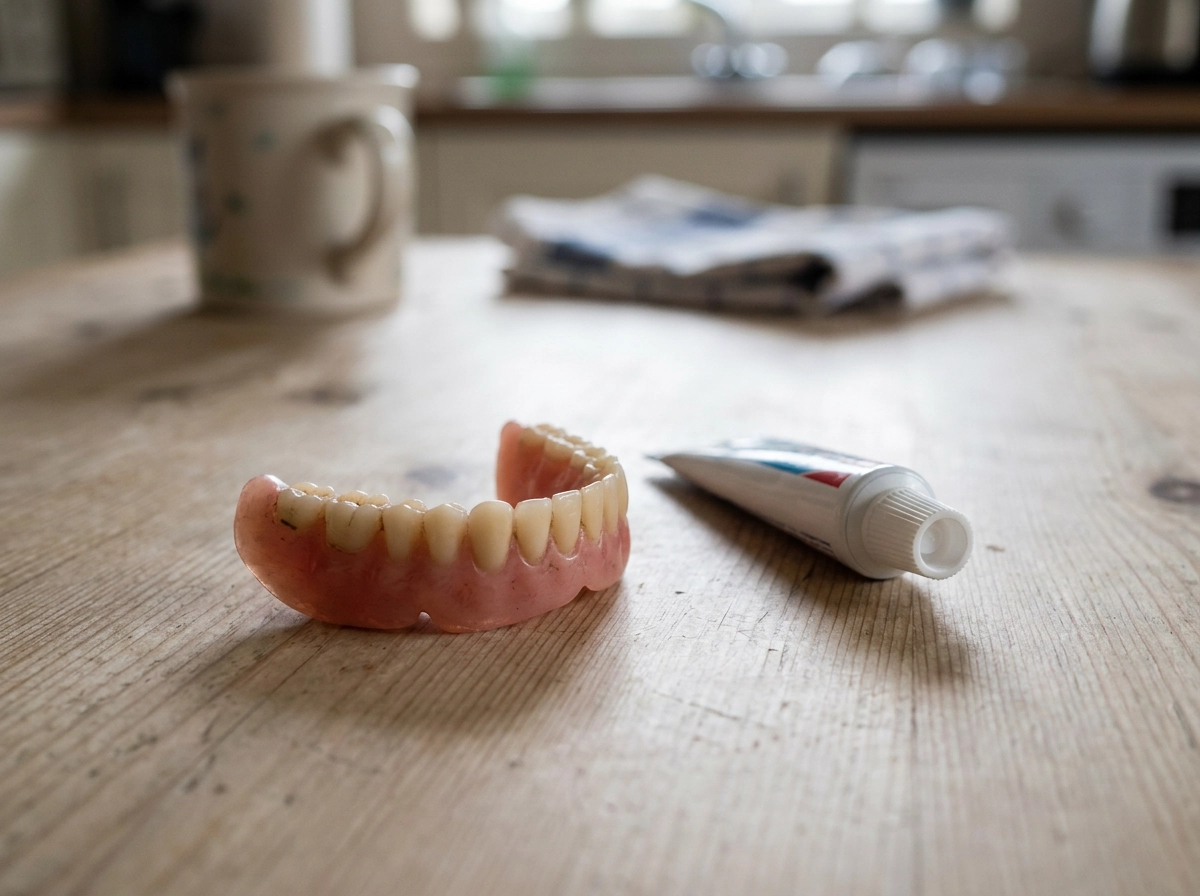
Ask people who wear conventional dentures about the lower one, and you will hear a familiar set of moments: it lifts mid-sentence, pops loose on a sneeze, or shifts on the first bite of something firm. Many keep adhesive within reach all day. This is commonly reported experience, not a measured study result.
Implant-retained overdentures work differently. Attachments, ball, locator, and bar systems among them, clip the denture onto implants, and a recent review of attachment systems notes the choice affects both function and maintenance.
The retention findings lean one way. The 2024 Peshawar study found implant-retained overdentures scored higher for stability and speech confidence.
Don't assume retention is automatic, though. Implant number, bone quality, attachment type, and how well the denture itself is made all shape how secure it feels. And a well-made upper denture can seal and hold comfortably on a favorable ridge when fit is maintained. The honest framing: clinical consensus and patient report, not controlled retention measurement.
Chewing: What Changes on Your Plate
Chewing is where a wobbly denture gets found out. Harder or tougher foods are the usual tests.
As noted in the overview, the 2024 Peshawar study found implant-retained overdenture wearers rated chewing comfort higher. A 2025 review in Eur J Ther likewise reported better masticatory efficiency with implant-supported overdentures, especially where ridge resorption is advanced. Researchers have also measured chewing efficiency and bite force directly in head-to-head trials.
Keep it honest, though: better chewing is not natural teeth. Bite force and food range can still be limited by the prosthesis and by how the implants are loaded. No source reviewed here quantifies a guaranteed improvement, and results vary with bone, health, attachment wear and maintenance. Be wary of anyone promising you a specific food list.
Sore Spots: Where Discomfort Comes From
Chewing comfort has a flip side: pressure. With a conventional denture, the base slides and rocks on the ridge, and that movement plus pressure commonly shows up as sore spots, most often in the lower jaw.
New dentures of either type usually need early adjustment visits while your mouth settles; a conventional denture may also need relining as the ridge changes shape.
Implant-supported dentures move less, so there's usually less friction against the gums. The trade: the implants and attachments now need cleaning and monitoring, and skipped hygiene can cause trouble around the implant sites, which is why the 2025 Eur J Ther review ties success to long-term maintenance protocols. Pressure discomfort can still show up over time, because ridges keep changing even with implants in place.
Treat this as commonly reported clinical experience, not measured data: the reviewed sources report no sore spot rates for either option.
Bone Change: The Slow Difference Nobody Sees
A sore spot is often the first sign of something slower underneath. Simply put, bone responds to load: where chewing force passes into the jaw, it tends to be maintained, and where it doesn't, the ridge gradually resorbs. Ongoing resorption is why a well-fitted denture can loosen over time.
Implants change that story by carrying load into bone. The 2025 review notes that tooth-supported overdentures maintained alveolar bone through retained roots, and implants work on a similar principle. Keeping roots or placing implants can keep more options open later.
Now the honest counterweight. Implants need enough bone to place, some patients require grafting first, and not everyone is a candidate.
Resorption doesn't stop with implants either. How much it changes for your individual mouth is not something any clinician can promise in advance.
Cleaning and Daily Upkeep: Two Different Routines
Bone change plays out over years. Upkeep plays out every morning, and that daily time commitment is the quietest difference between the two paths.
A conventional denture comes out, gets brushed, soaks overnight, and the mouth gets cleaned. Adhesive is there if you want it.
An implant overdenture also comes out, but now you're cleaning attachments and implant sites with interdental brushes and rinses, plus regular professional maintenance. As noted, the 2025 Eur J Ther review puts long-term maintenance at the centre of success. Upkeep, not surgery, sits at the center of the decision.
Fixed full-arch prostheses skip that removal step, but that design is a separate topic the reviewed sources barely cover.
Ask what upkeep looks like on an ordinary Tuesday, not just in month one. Our post-operative instructions page walks through cleaning and care after treatment.
Repairs, Adjustments and How Often You Are in the Chair
Daily upkeep is the routine; chair time is where the two paths really diverge. Conventional dentures follow impressions, fittings, and delivery, then occasional adjustments, relines, and repairs if a crack or fracture happens. Those problems can often be addressed. Implant-supported dentures add surgery steps: consult, imaging, placement, healing checks, and a conversion or reline once implants settle. They also bring wear items, since ball, locator, and bar attachments eventually need replacement. The research doesn't give visit counts, repair rates, or costs, so treat any figures as practice-specific estimates. Ask at your consult: how many visits each path takes in your case, what repairs cost, how long attachment parts last, and whether your denture needs remaking or only relining. What a visit involves can help you picture the implant-side flow.
Where Implant-Supported Dentures Ask More of You
Beyond the chair time, the implant path asks things of you before it ever begins. Placing implants is a real procedure with a healing period, and your denture may need to be worn differently or converted once the implants have integrated. Factors such as bone volume and overall health can affect whether implants are appropriate, and your clinician will assess candidacy individually. Budget and timing follow the same pattern. Implant-supported care generally costs more up front and takes longer to finish, though any price is office-specific, so ask for your own numbers. Hygiene around the implants, attachment replacement and maintenance visits are permanent parts of ownership, not a one-time add-on. And here is the fair part: the research favoring implants also concludes success depends on case selection. Implants are not universally better, only better for some mouths.
When a Well-Made Conventional Denture Is the Better First Step
If that list of trade-offs made implants sound like a stretch, hear this plainly: a well-made conventional denture is a legitimate first choice. It can be the right move for years.
The 2025 European Journal of Therapeutics review supports tissue-supported and tooth-supported overdentures as minimally invasive and cost-effective, which matters if you're medically compromised or want to avoid surgery.
Limited bone volume or a wish to skip grafting also pushes toward a conventional or tooth-supported design. Tooth-supported overdentures keep roots in place, preserving bite awareness and bone.
You get teeth sooner, too: lower up-front cost, faster delivery, no healing wait, simpler repairs. And starting conventional does not close the door on implants later. Ask about a staged approach; let your own clinician set the timeline, not an article.
Repairability is a genuine feature. A conventional denture can be adjusted, relined, repaired or remade, a real plus if you travel or want the simplest routine, and a common reason patients come in for restorative care.
What No Clinician Can Promise Either Way
That said, nobody can promise a set number of sore spots, a specific chewing gain, or that you will prefer the result. Bone, health, hygiene and design vary too much by person.
The evidence has limits. The cross-sectional design of the 2024 Peshawar study shows association only, not causation. The 2025 BMC Oral Health study of 29 patients found both groups improved with no significant differences, but it is one small study. Some sources are secondary summaries or were truncated.
No reviewed study reported cost, repair rates or visit counts. Money and time expectations get set locally, in person. That is part of what we are not promising, and why we are clear about what we do not promise and no guarantee of outcomes.
That 2025 conclusion applies equally here: individualized case selection, informed consent, long-term maintenance.
Weighing the Choice With Someone, Not Being Sold To
So bring those questions to a real conversation. Smile Studio of Rehoboth, a new dental office at 19411 Plantations Road, Rehoboth Beach, DE 19971, offers both dentures and dental implants, so you can compare paths in one place. Learn more about A Thoughtfully Designed New Dental Experience and Why patients may choose Smile Studio of Rehoboth. Treatment is planned with you, not presented to you, and findings are explained in plain language. Bring your health history and medications, what you actually eat in a normal week, how often you can come in for maintenance, and your budget range. The practice is opening soon and welcoming new patients, including year-round families across coastal Sussex County. Questions? Email info@rehobothsmiles.com.
Making the Call on Your Own Week
Before you decide, answer three questions: What holds this in place? What does upkeep look like in a normal week? What happens if it breaks or needs adjusting?
A conventional denture remains a legitimate first step, see the earlier section for the full case.
Have bone, health, and budget assessed before choosing. Those three factors, more than preference, decide which path is realistic.
If stability and chewing confidence matter most and you are a good candidate, an implant-supported denture may be worth the surgery, healing time, and extra upkeep.
Questions about either path? Email Smile Studio of Rehoboth at info@rehobothsmiles.com.
Conclusion
Both paths have genuine strengths; the deciding factors are bone, health, and budget, not preference alone.
Smile Studio of Rehoboth, at Plantations Road, Rehoboth Beach, DE 19971, offers both dentures and dental implants, so you can compare paths in one place. Email info@rehobothsmiles.com to ask questions. Choose the path that fits your real week, then move forward with clarity.