Waking up with a headache and a jaw that feels like it has been working all night is a confusing way to start the day. You did not chew in your sleep on purpose, yet your temples ache, your ears feel full, and your jaw is tired before breakfast. That pattern often points to clenching or grinding, and it is one reason people search for tmj dysfunction treatment. But a good exam does more than label the problem; it looks for the pattern behind it.
Here is what we will walk through: what a tight jaw plus morning headache usually means, how nighttime clenching shows up before you notice it, and the dentist's actual evaluation path. We will cover reading wear patterns and your bite, checking the jaw joint and muscles, and screening your airway and sleep history. Then we will explain what a night guard can and cannot do, when the next step is a physician, sleep study or physiotherapist, and what this practice will and will not claim about your outcome. By the end, you will know what to ask, what to expect, and how to take a sensible next step after a morning of jaw pain.

A Tight Jaw and a Morning Headache: What That Pattern Usually Means
Your chewing muscles and the temporomandibular joint, the hinge just in front of your ear, carry load for hours while you sleep. So the day often starts with jaw fatigue, temple pressure, and a headache that fades as you move around.
Two terms help. Sleep bruxism, the clinical term for jaw-muscle activity during sleep, which may involve grinding sounds or silent clenching, is one possible cause. TMD is an umbrella term for conditions affecting the jaw joint and the muscles that move it, not one disease.
Timing matters. In clinical practice, symptoms worst in the first hour after waking tend to suggest overnight activity, while symptoms that build through the afternoon may reflect daytime bracing, like holding your jaw tight at a screen or driving, and sometimes something that isn't dental, though this is a pattern rather than a rule.
A morning headache and sore jaw can come from clenching, a joint problem, a sleep breathing issue, or a headache condition with no jaw component. Coexisting problems don't prove one caused the other. It's a common reason patients come in for this, and the goal is finding the pattern, not assuming a cause.
How Nighttime Clenching Shows Up Before You Notice It
Clenching usually leaves evidence before you name it.
Worn enamel is the loudest clue, and it hides in plain sight: flattened cusps, shiny facets where grinding smoothed the biting surfaces, chipped or translucent front edges, and cold sensitivity as the protective layer thins. Wear often appears on posterior teeth and canines before the front teeth you see in a mirror, though patterns vary.
Jaw fatigue feels like a tired, stiff, heavy jaw on waking, trouble opening wide for the first bite of breakfast, or soreness after a long meal. That's the muscle pain in jaw people describe, a muscle-loading symptom, not a tooth one.
Ear and temple pain gets misread constantly. Because the chewing muscles are close to the ear, clenching pain is sometimes mistaken for an ear problem, but a dentist or physician can help distinguish them.
Note where your morning headache sits, how long it lasts, and whether it fades within an hour. That pattern helps your dentist separate muscle-driven pain from other headache types, and a physician may want it later.
Other clues: scalloped tongue edges, bite lines inside the cheeks, a partner who hears grinding, loose-feeling teeth with no decay, and daytime bracing. Daytime bracing adds to the overnight load; combined wear across 24 hours may exceed what nighttime alone would cause. A thorough dental examination reads these signs together.
Step One: Reading Wear Patterns and the Way Your Teeth Meet
Those clues are where the exam starts, then it becomes systematic.
We examine every tooth surface directly, documenting enamel wear, fracture lines, worn filling edges, and crown margins that opposing teeth have ground away.
Then comes your bite. Which teeth touch first? Has it drifted? Is a single tooth or restoration standing proud and absorbing most of the force? A high spot can concentrate load on one tooth and explain pain that has no other obvious source.
Intraoral photos and digital X-rays capture all of it, so next year's wear is measured against a baseline rather than eyeballed from memory. Change over time, not a single snapshot, is what teaches us the most.
We also ask about medications, medical conditions, diet, and habits like chewing ice or gum, nail biting, or holding objects with your teeth. Those add to the same load a night guard is meant to reduce.
That sequence follows the AAPD best practice document (2024 revision): TMD diagnosis rests on a screening history, a clinical examination, and diagnostic aids such as temporomandibular joint imaging when needed. One caveat, stated plainly: that document is written for children and adolescents, so it should not be generalized to adults without that caveat.
Step Two: Checking the Jaw Joint and the Muscles That Move It
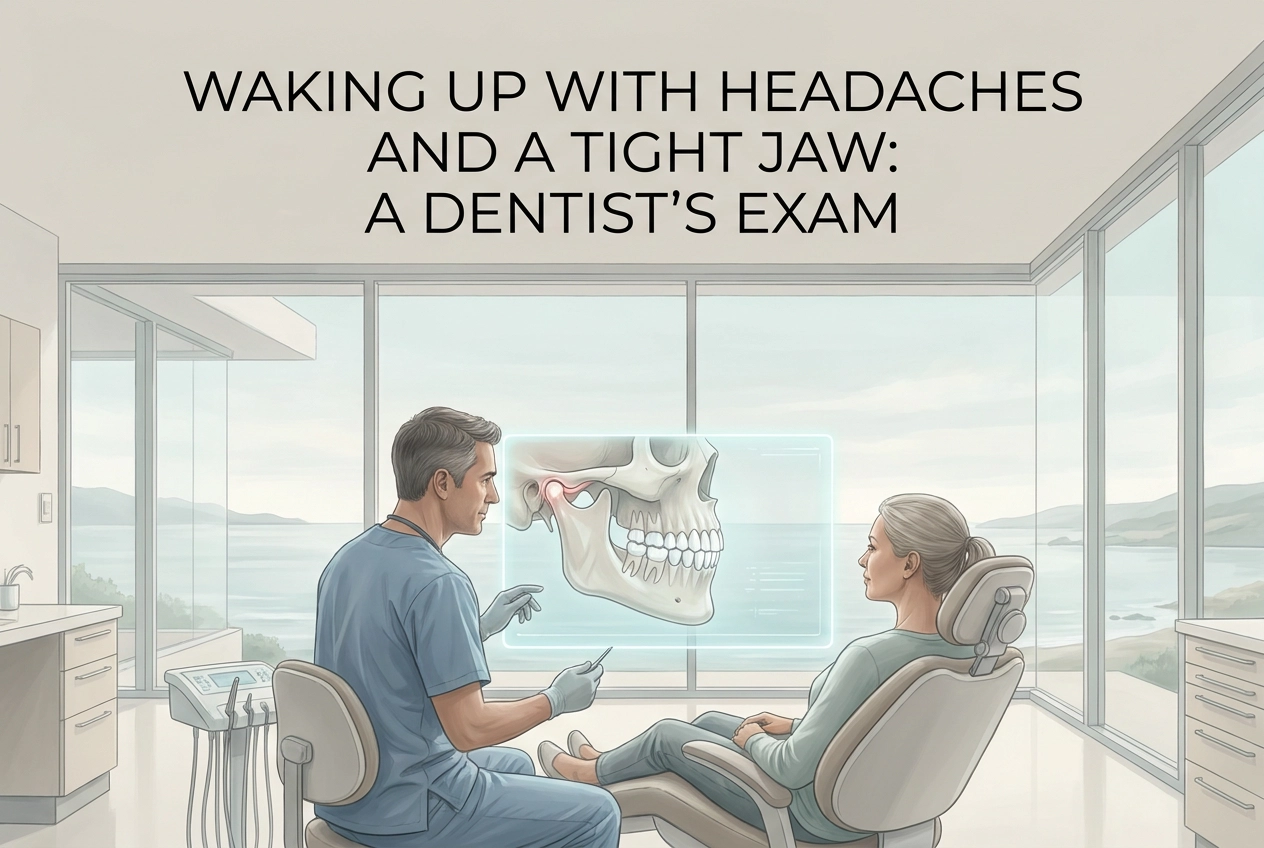
With wear and bite mapped, your dentist feels the muscles that move your jaw. Palpation means pressing along the masseter, the temporalis, and the muscles inside your mouth to locate tender spots and trigger points. They measure how wide you open and whether your jaw opens straight or drifts to one side.
They listen and feel over the joint while you open, close, and move side to side, noting clicks or grinding and whether those sounds hurt. A click without pain or restricted movement may not require treatment; best-practice guidance recommends starting with reversible options and avoiding irreversible steps without clear indication.
History matters: locking open or closed, painful chewing, a jaw that felt dislocated. Reported function guides care because the goal is restoring how you use your jaw, not erasing every sound.
Irreversible steps such as permanently reshaping tooth surfaces (occlusal adjustment), orthodontics, or surgery are not a starting point. Best-practice guidance puts reversible options first and aims at restoring function, decreasing pain, reducing risk factors, and improving quality of life, though that guidance comes from pediatric care and needs an adult caveat.
There is no single test. The pattern from wear, bite, tenderness, joint behavior, and history points to what to try first, and Dentistry That Looks Beyond the Tooth means explaining that pattern in plain language.
Step Three: Screening the Airway and Your Sleep History
The exam closes with your sleep history. We ask a short set: Do you snore, gasp or choke, or has anyone seen you stop breathing? Do you wake unrefreshed or feel sleepy during the day? Any dry mouth or sore throat in the morning? A yes changes where a jaw problem goes next; it does not mean every tight jaw is a breathing problem.
In the same visit, we note how you breathe (nose or mouth), tongue and tonsil position, scalloped tongue edges, and jaw position that appears to hold the airway open at night. Our Sleep and Airway Questions page walks through that screening in more detail.
Screening is a referral trigger, not a diagnosis. A sleep study (polysomnography) remains the diagnostic standard for obstructive sleep apnea, as noted above, and a dentist cannot order or interpret it.
The evidence is unsettled. Some clinicians believe treating sleep-disordered breathing eases TMD symptoms; a 2014 evidence-based review called that a growing trend with a questionable evidence base and causality not fully understood.
It still belongs because clenching, sleep breathing problems and jaw joint issues often appear in the same person. Appearing together is not the same as one causing another, and a night guard or jaw treatment will not fix a breathing problem.
What a Night Guard Does for Grinding Teeth, and What It Does Not Do
If your exam points to nighttime clenching, the next question is whether a night guard helps. A night guard for grinding teeth is a custom, removable appliance worn during sleep. It's reversible, which is why it comes early in the list of things to try.
It creates a barrier so enamel isn't grinding against enamel, and it absorbs some load that would otherwise hit teeth, fillings, and crowns. The clenching continues underneath; the teeth are protected while the pattern gets sorted out.
What it doesn't do, plainly: it doesn't stop the clenching, and whether it reduces headache frequency is not well established. Expecting a guard to end morning headaches? Hear that before the impression is taken, not after three months of wear.
Over-the-counter guards are a common first purchase; issues are usually fit, retention, and whether the biting surface matches your bite. That's the gap a custom appliance closes: a conversation about fit, not a sales pitch.
Treatment is planned with you, so the visit covers what the guard is for, what it won't do, what to check, and when to return for a fit review. A guard is one part of a plan that may include habit changes, physical therapy, or a physician referral. It replaces none of those.
When the Answer Is Not Dental: Physician, Sleep Study or Physiotherapist
Some exam findings point to a physician instead.
Loud snoring, witnessed pauses in breathing, waking up gasping, or heavy daytime sleepiness is a medical question. A dentist documents findings and sends a referral; diagnosis and the decision to order a sleep study belong to the physician.
A sleep study (polysomnography) remains the diagnostic standard for obstructive sleep apnea in adults when concern exists after a comprehensive sleep evaluation, as noted above, and a dentist cannot diagnose sleep apnea.
A dentist-made oral appliance can have a real role, but inside a physician-led plan for confirmed OSA. The AADSM and AASM issued a joint clinical practice guideline on oral appliance therapy in 2015.
Physical therapy is listed among the reversible TMD options, alongside behavioral therapy and occlusal splints. Guidance doesn't spell out adult referral criteria or outcomes, so what triggers a referral is a judgment call based on your exam findings. A physiotherapist works on jaw movement patterns, muscle tension, neck and posture habits, and self-management exercises.
A headache that is new, changing, has neurological features, or doesn't track with chewing and jaw use needs a physician, not more dental treatment. Specialty partners within the network support those referrals.
What This Practice Will and Will Not Claim About Your Outcome
Being specific about outcomes is part of an honest exam.
We will claim this: a thorough look at wear, bite, jaw joint, muscles, and sleep history; findings in plain language; a plan built with you, not handed to you; and a clear statement of which part of the problem dentistry can address. You can read more about what we will not do before you sit in the chair.
We will not claim that a night guard cures clenching, ends morning headaches, or prevents every chip and crack. No source supports those promises, and a practice that makes them is guessing on your behalf. Nor is there a permanent TMD fix to promise. The best guidance sets functional goals: restore function, decrease pain, reduce risk factors, improve quality of life.
Where evidence is thin, we will say so. The strongest TMD best practice document covers children and adolescents, sleep medicine guidelines are older, and the link between clenching, breathing, and joint problems is unresolved. Referrals get named, not absorbed: if your case belongs with a physician, a sleep study, or a physiotherapist, we will say so, even when that means less treatment here.
Your Next Step After a Morning of Jaw Pain and Headache
You do not need a diagnosis to take the first step. For two weeks, jot down when the headache starts, where it sits, how long it lasts, how tight your jaw feels, whether you snore or wake gasping, and whether movement or pain relief shifts any of it. That written history does much of the diagnostic work before you sit down.
Then book an exam that includes a wear and bite evaluation, a jaw muscle and joint check, and a sleep history, not just a cleaning. Smile Studio of Rehoboth is at 19411 Plantations Road, Rehoboth Beach, DE 19971, opening soon and welcoming new patients. Questions can go to info@rehobothsmiles.com. If you have a dental emergency, call rather than wait on a routine appointment.
Skip the third over-the-counter guard. If the first two did not help, the issue is usually fit and bite calibration, and you should know what a guard is for: protecting teeth while the cause is worked out.
If you snore heavily, wake gasping, or feel sleepy during the day, get a medical evaluation in parallel instead of waiting for dental treatment to explain it.
Keep early steps reversible. Protection, daytime habits, and physical therapy come first, with every finding explained plainly before you decide.
Conclusion
Morning headaches with a tight jaw often point to nighttime clenching or grinding, and the pattern matters more than any single symptom. A careful exam reads wear patterns and bite, checks jaw joints and muscles, and screens sleep history, because not every answer is dental. A night guard protects teeth, but it does not diagnose or resolve the cause. Keep early steps reversible: protection, daytime habits, and physical therapy come first, and referrals are named when another provider is the right fit.